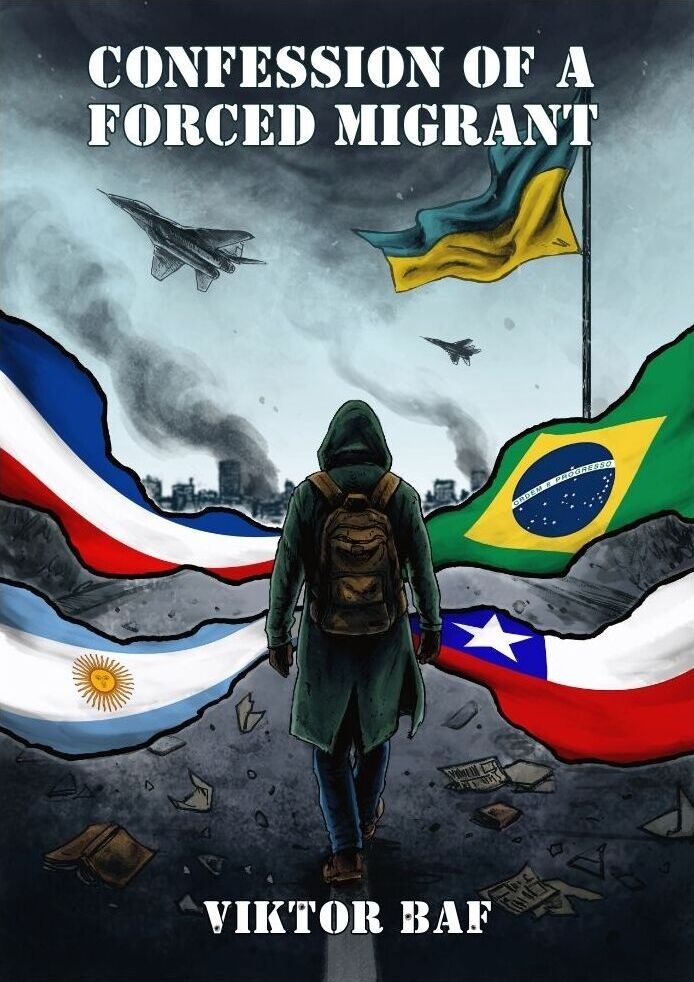
Confession of a Forced Migrant
Chapter 1
The day the war began
The morning of February 23, 2022, was not unusual or strange for me, but rather the most standard. As every day before, I woke up and went to work, where I worked at a regional television channel. I worked as a video editor, collecting news stories and programs, making titles for programs, and occasionally sitting on a prompter during live broadcasts.
And that morning, I drove out as usual in the direction of our office, and while I was driving, and nothing around me foreshadowed trouble, except for the Ukrainian army combat vehicles, which at that time were parked in a small cluster at the exit from the village where I lived. I did not attach much importance to this at the time, because the type of combat vehicles and their presence in those days had not been surprising for a long time, because the war in it had been going on in Donbas for about 8 years. Many times rockets flew into our the edges were flying away from us towards the occupied territories, so the military and their equipment were quite commonplace.
While I was on the bus, I was listening to music on my headphones and I wasn't looking at the Internet. When I got off at the stop I needed in the city, I saw that the gas station at one of the intersections was cordoned off by the police, and a little further away from them, a lot of military men in uniform were grouped around a truck. I thought, "another combat mission", but I didn't pay attention to what I saw, and calmly, at my usual pace, I walked on foot to the city center, to my work. I like long walk since my childhood, and it took me about one an hour to get there.
When I arrived at my workplace, I sat down at my PC and started opening the editing program, when suddenly came my colleague at work, Irina, somewhat funny in appearance, but in it’s own way attractive. She was very nervous and asked if I knew what happened this morning. At that moment, with us in the office was another our friend and video editor - Sasha, a large guy of athletic build, in addition, sometimes worked also as a trainer in the gym. He had a certain specific feature: one of his eyes was not real, although you wouldn't know it from the outside. He told me that as a child, he had been shot in the eye with a BB gun and had lost it ever since. However, this did not prevent him from becoming a good video editor and a similar sports coach. He was a brilliant guy! And he was also a great driver. Sasha and I didn't know what had happened until Ira showed up. She informed us that this morning, Russia attacked Ukraine. I remember I didn't even believe it; it seemed crazy to me. I started reading the news, and everything was confirmed: Russia attacked Ukrainian facilities all over the country. Unfortunately, it was true. If someone had told me a few years ago that this would happen, I would never have believed it. But the fact remains.
Naturally, on that day, our work took on a much greater meaning than on any other day, as we began to cover military events online and keep people informed about what was happening. There was a lot of work to do, and increasing every minute. It was like an endless avalanche of news. From that day on, our channel began to produce three or four news broadcasts a day instead of the traditional evening news broadcast. At that time, we had a wonderful director named Valentina, who was very demanding and very decent. Valentina was responsible for all the news broadcasts, and she had a mission. In her life, she had already escaped from the war at the beginning of the hostilities in Donbas in 2014-2015. Then she escaped from the pursuit, running on the roofs of buildings in Donetsk, when she and other employees of the Donetsk Channel were being chased by militia. She managed to escape. And now again. She was our main conductor, although she was on edge, tense as a string. Valya was acting abruptly and was very worried, but she still maintained the level of professionalism. That day, we produced many worthy news stories. Unfortunately, two years later, Valya will be gone…
But a new day came, and I went to work again. I remember taking my red bike, which I had recently bought for good money on the advice of a cousin. The bike was stylish, durable, cool, and looked very professional, but it didn't have fenders, which caused the mud from its wheels to splatter all over my clothes. The next day, I drove to work, and as I was driving, I saw multiple rocket launchers on the road ahead of me, grouped together to strike the advancing Russian troops. The “Grads,” as we used to call them, were stationed outside the village where I lived, not in it. But it was still alarming, as any missile salvo was a signal of a potential attack by the Russians, and it could have been directed at the private homes of innocent residents. Regardless, civilians are always more vulnerable in such situations.
On that day, I was cycling to work, passing familiar places, some of which would soon disappear from the face of the earth. But I didn't know that at the time, I was simply riding my bike, driven by the desire to get to work. In those days, I enjoyed my work more than ever before, feeling a sense of belonging to something that was important and meaningful to most people. At that time, television became a tool for me to inform the public about what was happening, and it was a good platform for me to express myself. I felt like I was a part of important events that the world was watching, as if I was at the center of the most significant things, and that was true.
It was exciting in the studio; everyone was worried, as something was happening. The morning news bulletin on 10, quick editing, the constant coffee nearby, and Valya's instructions. A well-coordinated, precise, structured work, I remember the mood as if it were yesterday. The first bulletin, then the second, the third, and immediately the fourth. At the same time, we were following the progress of the Russians along the border; they were getting closer. One village, another, getting closer to mine. Only the news reached us. Sasha went to withdraw all our money from our bank cards during a break, so that we would have at least some money. In those days, there were endless queues of people at the ATMs, trying to withdraw their money to survive, and the banks had limited the amount of cash that could be withdrawn to 1,000 hryvnias per attempt. The ATMs only dispensed 1,000 hryvnias, regardless of the amount on your card. Sasha stood there for a long time, but he completed his mission. I'm still grateful to him, because without that money, things would have been more difficult for me. He came back, gave us all our cards and our money, which he managed to cash, and joined in the work. We worked like a team, collaborating to achieve quick results. The boss came in and encouraged us. We had an interesting boss, and I liked him as a person. He talked to us and then left. And when the evening broadcasts were over and it was time to go home, there were already reports of missiles hitting the city's Left Bank. Then the lights went out. From the window of our office on the third floor, I could see that the Left Bank was plunged into darkness. But I knew that I would be going home through the Left Bank, and it was an exciting feeling, as the city was filled with anticipation. Life had come to a standstill. I didn't know that I would never see some of my colleagues again, and that the channel I had worked for five years would disappear forever in a few days. The office will be burned later, and I will see a photo of the building after the shelling. I will also see a video of the upper floors where our offices were located on fire. But that would be later, and at the time, after work, the building still looked good and functioned perfectly.
I said goodbye to my colleagues, took my sports bike, and went home through the night city. I remember the whole Mariupol on this last day, almost empty streets, no cars, few people, and the stopped factory "Azovstal". It was huge, stretched over a few kilometers. Along the fence of the factory was the route, and parallel to the route was the sidewalk, where I was cycling. For the first time in my memory, the factory was not working, but completely silent. A stopped-up metallurgical giant. Soon it would be made into ruins, but I didn't know that at the time.
I was driving and getting closer to the turn to Kalinovka - so was the name of the village through which I had to pass. A gloomy night, silence, a stopped factory, and an alarming atmosphere in the air, emptiness around and some people here and there on the streets. I remember I met a few cyclists on the way; some guys were riding on an empty highway, where there were no cars. They were joking, shouting, and discussing something. And I was thinking about that moment, in which there was something unforgettable, strange, memorable for life. And soon I turned off the main road and drove through the private sector. Even then, I could hear the sound of heavy artillery fire. At that time, the war in Ukraine was primarily an artillery war. I left “Azovstal” behind me, and I never saw it again. Many times before, I had passed through it, through its coal- and slag-laden trains, through its moving cranes and locomotives on the elevated areas, through its smoking chimneys, and through its endless metal structures, but now it was all coming to an end. The factory always gave me a bad feeling; it was a harsh place, even from the outside. I remember that there were always fishermen hanging out at the water discharge point from “Azovstal”, any Mariupol resident will remember that. I don't remember if I saw any fishermen with spiders and fishing rods by the river that night, but it's possible that someone was fishing near the factory, but I can't say for sure. In any case, the factory was already behind me, and I was moving on.
I was turning right in an adjacent street when I saw a Ukrainian armored personnel carrier with young boys was rushing somewhere ahead along the highway, speeding past the huge city dump, which was almost adjacent to “Azovstal”. These were large mounds of packed garbage, where thousands of seagulls circled from time immemorial in search of something to profit from the garbage. The armored personnel carrier was driving on the highway, and I was driving on the sidewalk. And somewhere in front of me, it stopped, and I turned off to the side, on the turn leading to Kalinovka. It was a cold day, and I was breathing steam, but I continued to drive, sinking into the darkness. The streets were dark, and part of the city and settlements where I passed were already without lighting. Moving down a private street, I saw how the sky was illuminated by flying shells of the “Grad” and somewhere in space, carried away by the sound of volleys. This is “Grad,” worked on by the Russians. And the further I moved, the stronger and more frequent shots were heard. Soon, the fences were replaced by the rumble of heavy artillery, sending shells into the darkness of the night into the unknown. It was like some kind of hell, no other way to describe it. All you could see was the glow, and the volleys, the glow and the volleys. Something was flying somewhere, but no one knew where. I didn't understand what was happening, and death could have come at any moment.
I continued to drive, passing by houses where candles or lamps were burning in the windows, gas generators were running, and people were anxiously discussing their concerns. At that time, no one could have known for sure what was happening. The sky and the earth continued to shake from the gunshots, and the shells flew into the air, cutting through the space, leaving only waves in their wake. The more I drove, the more I felt like I was going to some kind of hell, where there was only darkness, death, and fear. In the distance, the sky was sparkling, and the world was filled with danger.
After a while, Kalinovka came to an end, and I entered Sartana, a large Greek village known to many around it. It was once home to the beautiful singer Tamara Katsi, whose music videos I watched as a child on a birthday greeting program on TV, as some viewers loved her songs. It is a large and beautiful village. I loved it, and I still do.
And so I entered Sartana, and I heard the rumble of moving equipment, how it grows. Something heavy was being dragged through one of its main streets, and it was broken equipment. The equipment was coming from the battles for other villages, closer to the borders, from where the Russians were advancing. I remember that heavy sound, the grinding, it was not easy, but I decided then not to stop, but to go further - home to my family.
My hometown was also in darkness, no light, nothing around. When I reached the road where the wrecked equipment was being dragged, it had already disappeared somewhere in the distance. At the same time, I seemed to hear another vehicle coming down the road, but I didn't see it. When I rode my bike to the track, I saw only one consecrated stop at the local club. It was lit only because it was modern, equipped with solar panels and night lights, which gave it an ominous appearance in the midst of complete darkness. This is how I felt about reality at the time: dark, dangerous, and hellish.
But my family was waiting for me, and I was in a hurry to get home. I pushed my pedals harder and hurried to get out of the area so that I wouldn't be seen by the Ukrainian military, who might have mistaken me for a saboteur or a spy. I didn't want to get shot, and time was running out. Within half an hour, I was back home. Everyone already understood that change was coming, in its most drastic form, but we had no way to influence it. I remember arriving and meeting my dad, who was looking out of the house and standing on the steps. He asked if everything was all right. I said yes, and I went into the veranda, rolling in my red bike, which I had used maybe two or three times since I had bought it. That evening was a busy one, but it was only the beginning of things; the main events happened days later, and it developed very rapidly.
(End of the sample excerpt)