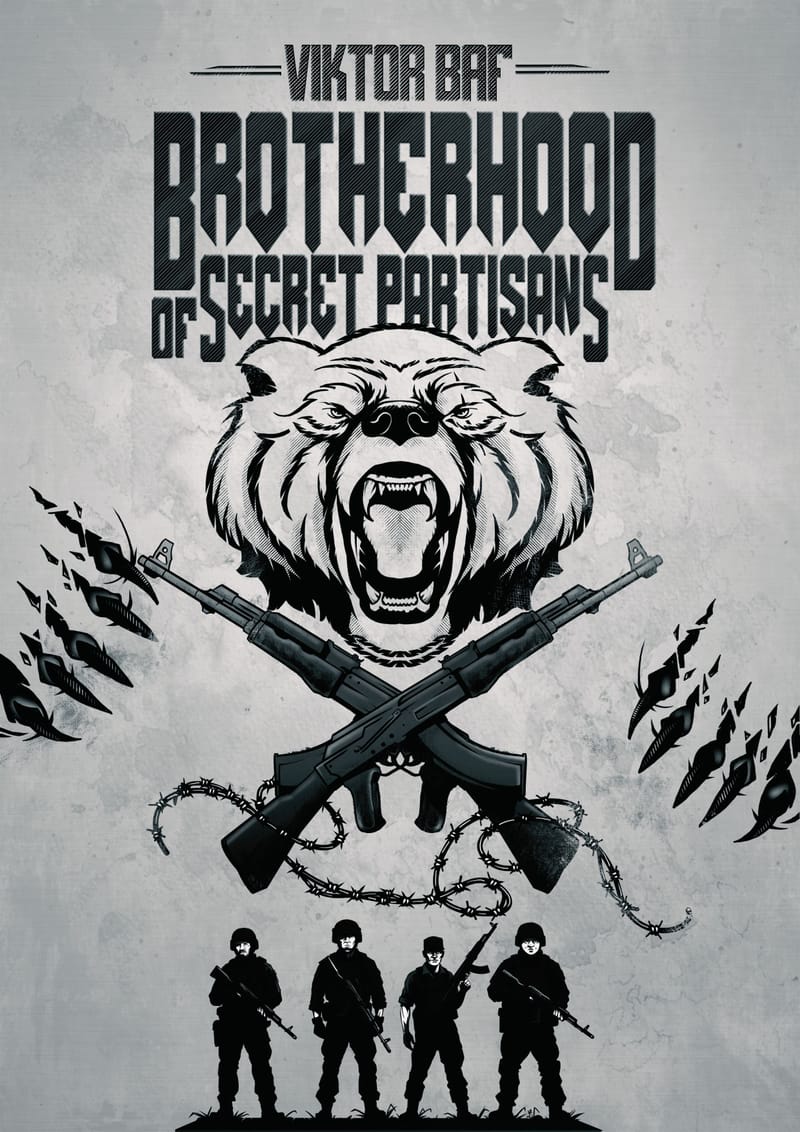
Brotherhood of Secret Partisans
1
In the courtyard between a cluster of apartment buildings, a group of men in their fifties sat around a homemade wooden table painted green, playing dominoes. As was customary, they swore now and then, yet remained completely absorbed in the game. When the next domino tile landed on the tabletop with a sharp clack, the table suddenly began to wobble. Moments later, it shook again—this time even harder—drawing puzzled looks from the players. They stared at the table in bewilderment, as if expecting it to tip over at any second, but it merely continued to vibrate. Then, in rhythm with the table, the benches they were sitting on began to tremble as well, followed by the ground beneath their feet, as though an earthquake had struck. They exchanged confused glances, silently asking one another, What on earth is happening?
Meanwhile, a convoy of menacing trucks thundered down the city's main avenue at full speed, their massive wheels crushing the sun-baked asphalt beneath them, their engines roaring like lions. They barreled past—huge, heavy, terrifying—and everything around them rattled from the force of their passage.
Nearby, on the veranda of a café overlooking the avenue, a young waitress was watering a row of potted flowers. Her yellow-and-red gerberas, white hydrangeas, and pink pelargoniums trembled as though frightened, shaking harder and harder while the trucks hurtled down the street like monsters.
The truck leading the convoy paid no attention to anyone else on the road. It seemed ready to plow straight through anything or anyone that stood in its way, charging ahead like a runaway beast. The road ahead cleared almost instantly. No one wanted to be crushed beneath those enormous wheels, so every driver quickly pulled aside or onto the shoulder to let the convoy pass. The truck drivers kept their feet pressed hard on the accelerator, and the thunder of their engines echoed in every direction.
As the convoy drew closer, the dishes in the surrounding homes began to rattle as well, clattering and practically bouncing in place as though the ground itself were trembling beneath them. They shifted inside cabinets and across tabletops. Along with them, other household items began to vibrate—clothes hanging on hangers, figurines, framed family photographs, pots with food still inside, and even household appliances. Everything trembled and shook as if the Apocalypse itself had arrived.
Yet the relentless convoy kept coming, and no one could stop it. Emblazoned on the trucks’ metal KUNG bodies were falcon emblems alongside the mysterious inscription “GOR.” Even the tires of those massive machines bore engraved falcons, though the markings were impossible to make out as the convoy sped past. The instrument panels inside the trucks carried the same falcon symbol, which also appeared on the drivers' uniforms. One design. One color. Everything was identical. The driver of the lead truck wore glasses that concealed his eyes, while his face remained as hard and unyielding as steel. He looked like a man eager to crush someone beneath his wheels.
Whenever the traffic light turned green, pedestrians still didn't dare step off the curb. The sinister convoy was rapidly approaching from afar, relentless and fast, without stopping even for the yellow light. Every truck was equipped with a siren whose piercing wail echoed in every direction. Pedestrians, other vehicles, and even the birds that crossed the convoy's path all tried to avoid any direct encounter with the relentless procession, if only to keep from attracting the dangerous attention of its drivers. Boys on bicycles and skateboards stopped riding and scattered in every direction to hide. Children abandoned their games in the sandboxes, and even the little girls grew suddenly serious, leaving their dolls where they were. The moment they heard the wail of the sirens, they all fled in fear. Young couples jumped up from the benches and hurried into courtyards or behind trees, fearfully watching the dark green trucks roll past. Small children hid in their rooms, scrambling beneath their beds. "CLOSED" signs were hastily hung in shop windows until the endless line of monstrous vehicles disappeared from sight.
Bringing up the rear of the convoy was a swamp-green UAZ-469. Behind the wheel sat Commissioner Herman, his hand, adorned with a large gold-plated signet ring, firmly gripping the steering wheel as he guided the vehicle directly behind the last truck in the convoy. The official's face was fierce and intimidating.
At the intersection, the entire convoy turned left and disappeared from sight. As it moved away, the trembling of the earth faded with it.
This was exactly how Commissioner Herman imagined the arrival of his own Group of Operational Response, known by the abbreviation GOR, in his unhealthy imagination. A man consumed by delusions of grandeur, he believed that everyone around him should fear him.
2
An unfamiliar young man frantically rifled through the folders on his desk, searching for something among the documents inside. He swept folders, notebooks, and sheets of A4 paper aside in mounting frustration. None of it was what he needed.
“Where the hell are you, for crying out loud?” he shouted helplessly.
He glanced at the wall clock. It was five minutes to four.
With renewed urgency, the poor guy flung papers in every direction, trying to find the one he needed. Meanwhile, the wail of the siren drew closer. Yet even that failed to jog his memory. Where had he put that damned project? Terrified, like an animal cornered by hunters, the young man yanked open one drawer after another, hurling out their contents while casting feverish glances at the clock.
3:57 p.m.
The minute hand advanced by one more minute. The poor fellow began rummaging through his briefcase, then moved on to a second desk, while the siren outside grew louder. The sound of approaching vehicles was now very close.
A convoy of several GAZ-66 trucks arrived, accompanied by a single UAZ-469, kicking up clouds of dust from the cinder road outside his window. The dust settled over the flowers in the beds beside the house—the flowers his mother had planted with such care.
They had come for him, the “habitual offender” who had failed to turn in his assigned paper on time. Knowing he was guilty, he was beside himself with anxiety.
3:59 p.m.
There it was! The one. The precious one. The young man opened the folder and read:
“Research paper. Yes!” he cried, triumphantly raising the important document over his head. “Found you, baby.”
Illuminated by the bright daylight, people in military-style uniforms began stepping out of the murky green KUNG compartments. However, their grim, expressionless faces showed nothing but a desire to punish the culprit. Thirty-two people. Each of them carried an Esaul-3 traumatic pistol, a radio, handcuffs, and PR-73F batons. They formed a semicircle in front of the house, waiting for orders.
Meanwhile, the siren on the UAZ at the rear of the convoy sputtered and went silent. The commissioner stepped out of the vehicle, adjusting his black peaked cap. His expression was extremely serious—the kind of look you would expect from a true villain in a cult classic movie. His reflection briefly appeared in the vehicle’s rearview mirror as he moved slowly and confidently toward the house.
The young man peeked out the window and, horrified, discovered that unfriendly visitors had already lined up at the gate of his house. The unfortunate young man walked to the front door and quickly put on his shoes while his mother stared at him with wide eyes. It seemed that at any moment she might burst into tears.
4:02 p.m.
The commissioner glanced at his wristwatch, then at the yard gate. He walked toward it.
At that moment, the young man stepped out of the house with a folder in his hands, holding the important papers high above his head.
The commissioner stopped a meter away from the gate. The young man opened the folder in his hands, showing its contents to Herman. Behind the window, the young man’s mother silently watched the scene unfold. The commissioner took the folder from him, read the title, then quickly scanned the text on the first pages. Satisfied, he finally smiled. After that, he wagged a finger at the young man as a warning, as if saying, “Naughty, naughty. That wasn’t a good thing to do.”
“I don’t like it when students miss their deadlines. Oh, how I don’t like it.”
“Yes, Commissioner Herman Karlovich, please forgive me. I’m at fault. It won’t happen again,” the young man said, embarrassed, trying to explain himself.
The commissioner gave him a fatherly pat on the cheek, just as Hitler once patted a boy from the Hitler Youth, and said:
“I hope so. I hope so.”
***
At that moment, Herman, who had been dreaming of this masterpiece of his own fantasies, woke up. Still lying in his bed beneath dark-blue covers, overwhelmed by a euphoric sense of his own importance, he smiled and whispered into the empty room:
“You little brats... I’ll teach you a lesson.”
3
A dart suddenly slammed into the enlarged photograph of the smiling commissioner, which had been placed exactly in the center of a dartboard. Then a second one followed. The photograph had already been badly damaged by the many darts that had struck it before, leaving countless holes across the image.
The photograph of the “Führer,” as Zhenya himself had nicknamed the commissioner, became the target of darts thrown by him and his friends. Together, they mercilessly mocked Herman, calling him everything from “the Führer” and “the regime’s Gauleiter” to “the idiot in the cap” and many other names. The young men held nothing back, taking turns throwing sharp darts straight at his face.
Zhenya’s two friends, Ivan and Eldar, took part as well. The three of them discussed the harsh education reform introduced by the Ministry of Education, which had practically turned into a Ministry of the Army. In essence, it had created a repressive system for controlling the academic performance of students from poor and ordinary families while preventing them from obtaining higher education. The education reform, which continued to be imposed after the relatively recent end of the war, included a drastic reduction in the number of universities, along with their merging and consolidation. At the same time, vocational schools were to be expanded as much as possible, with more and more young people being directed there—not through personal choice as in previous years, but through various forms of pressure, including social pressure.
One of the restrictions imposed by the new system was financial inequality and class injustice. The right to receive an education and earn a degree had recently become a privilege reserved for the children of government officials, war heroes, and the wealthy. The children of ordinary citizens, even if they were three Einsteins and five Mendeleevs rolled into one, could aspire only to menial positions in factories and industrial plants—or, at best, to becoming shop-floor supervisors. Under the ministry’s new plan, they were not entitled to anything of higher status. Going abroad was not an option either. The government had imposed a ban on foreign travel for anyone aged fifteen or older, because the country needed “working hands.”
The commissioner, meanwhile, was an official appointed from above to enforce the newly introduced rules and monitor the academic performance of “lower-class youth.” As a result, every student soon knew who he was, and they all hated him in equal measure. Since the system was still being tested, Herman was permitted to visit the city’s institution of higher education, where the privileged children of wealthy families studied, though he had no authority there whatsoever. The university had its own system of student oversight, based more heavily on rankings and strict regulations.
Herman Karlovich had thirty-two men under his command—men with more muscle than brains. Each man was armed with a rubber baton and a less-lethal pistol. Collectively, they were known as the GOR—the Group of Operational Response—or by their second name, the GEEE: the Group for the Effective Enforcement of Education. One of the unit’s primary tasks was to suppress any potential unrest among vocational students should they rebel. It was also responsible for overseeing the quality of the educational process throughout the entire secondary vocational institution, rather than monitoring only individual students. Herman himself had been assigned the city’s principal specialized vocational institution: the IMVS—the Industrial Municipal Vocational School.
There was good reason to dislike and despise the commissioner, since he was a rather rotten sort of man. The students at the IMVS immediately took against both him and the entire GEEE unit, seeing the latter as nothing more than the regime’s chained guard dogs.
Take, for example, a young man named Yevgeny. He had been denied the chance to study to become a software analyst. His written petition for permission to enroll in a university had been rejected despite all his achievements in programming, app development, and other demonstrated skills. The rejection was indefinite, while the Ministry of Education had put university education in other cities on hold because of unresolved flaws in the ongoing reform. A substantial majority of young people had found themselves in the same position.
These and other adverse circumstances led Yevgeny to believe that a united force of resistance had to be formed against the state concentration-camp system now being built, and that it had to be crushed through collective effort—dragging down from their pedestals lackeys like the commissioner and his pathetic henchmen before they acquired even greater power.
“But how are we supposed to do that?” Yevgeny asked his friends as he considered how they might resist the system.
“We need to overthrow them by force,” Ivan suggested.
“A revolution?”
“Yeah. Why not? They don’t give a damn about us, so why the hell should we handle them with kid gloves?” he said harshly, hurling another dart at the commissioner’s mug. The dart lodged squarely in the target. “I’m serious. Let’s set this in motion. Somebody always has to be the first—Lenin, Cromwell, Bolívar…”
“Castro. Che Guevara,” Zhenya added.
“Yeah, exactly,” Ivan picked up. “Che Guevara, Fidel Castro, Pancho Villa, Mao Zedong…”
“Gandhi, Prabhupada, Martin Luther,” Eldar joined in.
“Who are they?”
“Spiritual revolutionaries.”
“Spiritual? I don’t think spirituality is going to do us much good right now,” Ivan concluded skeptically, confidently sending another dart into Herman’s eye.
“Uh… Lenin isn’t exactly the best example either.”
“That’s not the point. He overthrew the tsar and brought down the system, so he counts. What matters is that we can repeat what they accomplished and drive this whole mob out of their cushy positions—all those worthless opportunists, ass-kissers, goddamn ‘Führers,’ and the rest of their pathetic ilk,” Ivan ranted, throwing another dart, which pierced the commissioner’s forehead this time. The other guys added a couple of their own—to his chin and nose.
“Every revolution claims a great many lives,” Eldar reflected aloud.
“What can you do? You always have to sacrifice something—time, money, health, your future, or something else. Freedom is never given freely. You have to fight for it, win it for yourself, understand? Otherwise, what value would it have? You can’t truly appreciate something you never risked anything for and never worked to attain. That’s not how the world works.”
“I agree,” Eldar replied.
“You’re a religious man. Think of how Christians—and other religious people as well—were persecuted by the authorities and by all kinds of criminals. If they hadn’t fought back, how could they have become martyrs? How could they have established their knowledge as authoritative? It would have been impossible. Even spiritual people are fighters. They simply use nonviolent methods, that’s all. But this world is woven from struggle, Ilya. You need to understand that. It is saturated with one group fighting another. In nature and in human society alike, the strongest prevail. That is why we have no right to be weak, or we’ll be trampled underfoot.”
Ivan called Eldar “Ilya” only when he wanted to get under his skin without actually offending him. The two often engaged in friendly arguments because Eldar did not support radical measures, although he understood their importance. Ivan, by contrast, did not consider peaceful methods particularly acceptable, either for himself or for society as a whole, and regarded them with irony. From time to time, he teased his friend, making it clear that he did not believe love could be absolute in the world as it currently existed.
“I’ve got an idea, guys,” Zhenya joined in. “First, the three of us need to establish ourselves firmly. Then we can gather like-minded people around us—people like us. I suggest we take an oath.”
“What kind of oath?”
“An oath of loyalty to our mission. From now on, we have one: to free ourselves and others from slavery. What do you think?”
The other two thought it over for a moment and agreed.
“Then here it is: I declare that a real brotherhood is being formed here and now. The Brotherhood of…” He paused to think before saying, “The Brotherhood of Secret Partisans. That’s what we’ll call ourselves. How does that sound?”
“Sounds good, brother,” Ivan said with a smile. “I personally like it. What do you think, Eldar?”
“Works for me too.”
“Excellent, brothers. From this moment on, the Brotherhood of Secret Partisans begins to grow. I think I even know what our emblem will look like. I’ll draw it myself and show it to you soon. I swear to you that until we put an end to the use of force against us and our generation, the struggle will continue. Are you with me?”
“I’m in,” Ivan replied without hesitation.
Eldar hesitated, having quickly realized what all this might lead to. Nevertheless, out of loyalty to their many years of friendship, he declared that he was prepared to stand by the others to the very end. Although he did not fully support a violent overthrow or militant struggle, he saw no other way to defeat the slaveholding, militaristic regime that was rapidly gaining power in the country. And so, in the end, he agreed.
“I’m with you, my friends. To the very end. We’ve been like brothers since childhood. Wherever you go, I go,” Eldar pledged.
“Excellent, brother!” Yevgeny exclaimed enthusiastically. “I swear to remain faithful to our mission to overthrow the regime and always prove myself worthy of being a partisan.”
“I swear,” Ivan joined in.
“I swear too,” Eldar promised.
“I’m proud of you, brothers. We’ll give them hell,” Yevgeny said, fired with enthusiasm.
With that, he turned toward the target and hurled not a dart but a steel knife at the commissioner. The blade nearly split the dartboard in two, and Herman’s hole-riddled photograph tore free from it and fell to the floor, drawing a loud cheer of approval from all three friends.
4
Night had already fallen when Yevgeny set about creating a symbol for the partisan movement. He knew a great deal about partisan resistance as a phenomenon from books and films, particularly from the history of the Great Patriotic War and the Cuban revolutionaries’ resistance. He also held Che Guevara’s Guerrilla Warfare in high regard. A plan to overthrow the government had long been taking shape in his calculating mind, but all that time he seemed to have lacked the courage, the initiative, or some kind of push from above that would open the doors to the world of struggle. He was cautious by nature, always trying to calculate every possible outcome and avoid making a mistake. At last, the hour had come. The time was drawing near for fierce bears and lone wolves to unite and tear out the throats of the overfed pigs.
Zhenya sat at his desk at home, considering what he should put on paper. He looked through images online—various works of digital art, illustrations, and portraits—searching for something he could build on. He was determined to invest the symbol with rage, courage, force, aggression, and strength, so that the very sight of the emblem would frighten the enemy while inspiring him and his comrades. But which animal embodied such a nature? The image of a bear’s head with its jaws wide open came to him. Zhenya was a decent artist, so drawing the beast was not particularly difficult for him.
When the predator’s likeness was finished, the young man leaned back and looked down at it. Something was missing. Weapons! Once he realized that, he added two Kalashnikov rifles crossed over one another. Beneath them, he wrote three words: Brotherhood of Secret Partisans, abbreviated BSP. It seemed simple enough, yet how exciting it was! As he worked on the emblem, Yevgeny also decided to develop a covert system for transmitting information within their movement—one that only members of the Brotherhood would understand and that would remain concealed from everyone else. He planned to begin developing the concept a little later.
Having finished his work, the genius saved it to his phone and printed it out, deciding to present the symbol he had created to his friends—who were now also his partisan brothers—the very next day. Naturally, he would tell them more about what else needed to be done to improve their combat organization and would listen to their suggestions as well.
(End of preview excerpt)